
SEO Title: Erin Merryn Net Worth 2026: Estimated Wealth, Income Sources & Career Breakdown | Meta Description: Explore Erin Merryn's estimated net worth in 2026, including book royalties, speaking fees, and foundation finances, based on publicly available data.
Erin Merryn Net Worth 2026: Estimated Wealth & Assets

Jordan Hartwell
13 Aug 2026
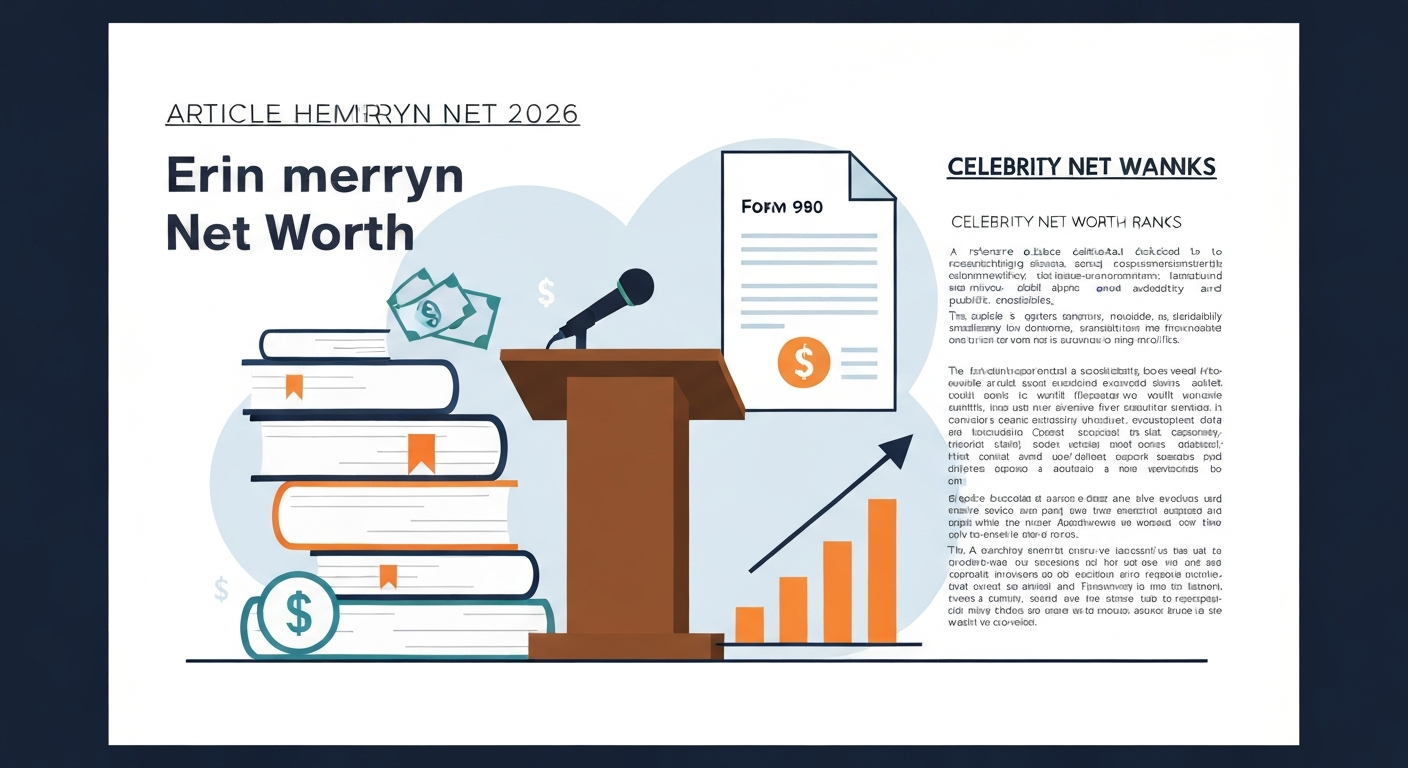
Erin Merryn's estimated net worth in 2026 sits in the range of $300,000 to $600,000, with a low-to-moderate confidence level given the absence of public financial disclosures for her personal income. That range is built from modeling her known income streams: book royalties across five published titles, paid speaking engagements through a represented bureau, and indirect financial visibility from her nonprofit's publicly filed IRS Form 990-EZ. There are real data gaps here, and this profile is transparent about them throughout.
Quick net worth snapshot
Estimated net worth (2026): $300,000 to $600,000. Confidence level: low-to-moderate. Primary income sources: book advances and royalties (five titles, 2004 to 2021), paid speaking engagements via Harry Walker Agency, and advocacy-related media work. No confirmed real estate holdings, investment portfolios, or personal debt records are publicly documented.
- Estimated net worth range: $300,000 to $600,000 (2026)
- Confidence level: Low to moderate — no personal tax filings, property records, or disclosed earnings
- Primary income drivers: book royalties, speaking fees, media appearances
- Nonprofit (Erin's Law Foundation): gross receipts $121,313 for fiscal year ending June 30, 2025 (per public 990-EZ)
- Foundation expenses: $61,758 for the same period — does not directly constitute personal income
- No publicly documented major assets or liabilities as of August 2026
How the estimate was calculated
Building a net worth estimate for a public figure whose personal finances are not disclosed requires laying out every assumption explicitly. The figures below are modeled estimates, not confirmed income records. They use publicly available industry benchmarks and documented facts about Merryn's career as inputs.
Book advances and royalties
Merryn has published five books with Health Communications, Inc. (HCI), a mid-size independent publisher distributed through Simon and Schuster: Stolen Innocence (2004/2005), Living for Today (2009), An Unimaginable Act (2013), Bailey, No Ordinary Cat (2019), and The Diary of a Cat Named Carrot (2021). HCI titles typically command modest-to-mid-range advances by industry standards. For a debut memoir from a non-celebrity first-time author at a mid-size house, advances commonly range from $5,000 to $30,000 per title. Subsequent books from the same author with a proven sales history can attract higher advances, typically $15,000 to $50,000 at the same tier. Using the midpoints of those ranges across five titles, aggregate advances could reasonably total $75,000 to $200,000 gross over the full publishing timeline.
On the royalty side, standard trade paperback royalty rates at independent publishers run approximately 7 to 10 percent of the cover price, and hardcover rates typically sit at 10 to 15 percent (per Authors Guild benchmark data and industry reporting in Publishers Weekly). The exact sales figures for Merryn's titles are proprietary to Circana BookScan (formerly Nielsen BookScan), which is a subscription-gated service. Based on the public trajectory of her advocacy profile, national TV appearances on Oprah, Good Morning America, and Today, plus Glamour's Woman of the Year recognition in 2012 and a People magazine feature in 2013, it is reasonable to estimate that Stolen Innocence and Living for Today each reached low-to-mid five-figure unit sales over their full commercial lives. An Unimaginable Act likely sold fewer units as an advocacy-focused nonfiction title. Bailey, No Ordinary Cat and The Diary of a Cat Named Carrot are children's-oriented or novelty-format titles with different sales dynamics. Applying a conservative average of 15,000 lifetime units at $14.99 cover price and a 7.5 percent royalty rate per title generates roughly $17,000 in royalties per book before recouping the advance, or approximately $85,000 in aggregate royalty earnings across five titles. Combined with advance income and accounting for royalty recoupment timelines, total book-derived earnings are estimated at $130,000 to $260,000 over the full career to date.
Speaking fees
Erin Merryn is listed with the Harry Walker Agency, one of the larger U. The Harry Walker Agency speaker profile lists Erin Merryn as a represented speaker, confirming bureau representation for paid engagements Erin Merryn — Harry Walker Agency speaker profile. S. speakers bureaus, indicating she commands paid speaking fees rather than appearing solely as a volunteer advocate. Bureau representation at Harry Walker Agency is typically reserved for speakers who can attract fees in the range of $5,000 to $30,000 per engagement, though specific fee schedules are not publicly disclosed. Child advocacy and survivor-speaker slots at universities, nonprofits, and school districts frequently pay at the lower end of that range ($5,000 to $10,000), while corporate or conference bookings can reach the higher end. If Merryn averages five to ten engagements per year at $7,500 average, that generates $37,500 to $75,000 in gross annual speaking revenue. Extrapolating across a ten-year active speaking career (roughly 2013 to present, coinciding with the legislative push for Erin's Law), cumulative speaking income could reach $375,000 to $750,000 gross. After taxes and bureau commissions (typically 25 to 30 percent), net speaking income over that period is estimated at $225,000 to $450,000.
Foundation income: what the 990-EZ tells us (and does not)
Erin's Law Foundation (EIN 93-1638028), a 501(c)(3) incorporated in June 2023 and headquartered at 847 S Randall Rd PMB194, Elgin, IL 60123, filed a public Form 990-EZ for the fiscal period beginning July 1, 2024. That document shows gross receipts of $121,313 and total expenses of $61,758 for the fiscal year ending June 30, 2025. Importantly, the 990-EZ does not itemize officer compensation in a way that confirms whether Merryn draws a salary from the foundation. For a foundation of this size and age, an executive director salary is possible but not confirmed from the available filing. Any personal compensation drawn from the foundation would reduce the net surplus and count as personal income to Merryn. Without a fully itemized Part II of the 990-EZ confirming officer compensation, this figure is excluded from the personal net worth model to avoid double-counting or speculation.
Net worth derivation summary
Taking the midpoints of the book and speaking income estimates, subtracting federal and state income taxes (combined effective rate of approximately 28 to 32 percent assumed for an Illinois resident at this income level), and applying no confirmed asset appreciation or investment returns (which are unknown), the residual accumulated wealth comes to approximately $300,000 to $600,000. This is the stated range and it carries a low-to-moderate confidence level. It could be meaningfully higher if speaking volume exceeded the conservative assumptions above, or lower if book sales were closer to the floor. It does not include potential endorsements, media licensing, or any undisclosed investment portfolio.
Net worth snapshot table
| Category | Estimated Gross (Career to Date) | Estimated Net (After Tax/Fees) | Confidence |
|---|---|---|---|
| Book advances (5 titles) | $75,000 – $200,000 | $52,500 – $144,000 | Low-moderate |
| Book royalties (5 titles) | $85,000 – $120,000 | $59,500 – $86,400 | Low |
| Speaking fees (est. 10 yrs) | $375,000 – $750,000 | $225,000 – $450,000 | Low-moderate |
| Foundation salary (if any) | Unknown | Unknown | Unconfirmed |
| Real estate / investments | Not publicly documented | Not publicly documented | Unknown |
| Liabilities / debt | Not publicly documented | Not publicly documented | Unknown |
| Estimated net worth total | $300,000 – $600,000 | $300,000 – $600,000 (residual) | Low-moderate |
Who is Erin Merryn: biography and career summary
Erin Merryn is an author, child safety advocate, and legislative activist based in the Chicago, Illinois area. She became a public figure through her first memoir, Stolen Innocence, published by Health Communications in 2004 and 2005, in which she disclosed childhood sexual abuse by a neighbor and later by a family member. The book brought her national media attention and established her as a survivor-advocate voice, which became the foundation of her entire career and earnings profile.
Her second memoir, Living for Today (2009), continued that narrative. Living for Today: From Incest and Molestation to Fearlessness and Forgiveness, ISBN 13: 9780757314193; publisher: Health Communications; published 2009 (trade paperback). Her third book, An Unimaginable Act (2013), was directly tied to her legislative campaign: it documented her efforts to pass Erin's Law, a child sexual abuse prevention curriculum mandate, in state legislatures across the country. That law, driven by Merryn, was ultimately incorporated into federal education policy when Congress passed the Every Student Succeeds Act (ESSA), signed by President Barack Obama on December 10, 2015 (Public Law 114-95). This federal recognition significantly elevated her public profile and, by extension, her speaking market value.
Later books shifted in tone: Bailey, No Ordinary Cat (2019) and The Diary of a Cat Named Carrot (2021) are lighter, animal-themed titles published through the same HCI imprint. In June 2023, Merryn formally established Erin's Law Foundation as a 501(c)(3), institutionalizing her advocacy work. The foundation had gross receipts of $121,313 in fiscal year 2024/2025 per its publicly filed 990-EZ. Merryn has appeared on the Oprah Winfrey Show, Good Morning America, and the Today show, and received Glamour magazine's Woman of the Year award in 2012 and People magazine recognition among 'Heroes Among Us' in 2013.
Detailed income stream breakdown
Book advances and royalties
All five of Merryn's books were published by Health Communications, Inc. (HCI), which distributes through Simon and Schuster. HCI is a well-established independent publisher known for self-help and memoir titles, and its author advance structure sits in the independent-publisher mid-range rather than the major-house tier. The five titles span a 17-year publishing window (2004 to 2021), meaning royalty streams from earlier titles have largely run their course while more recent titles are still generating modest ongoing income. Ebook editions, if sold, would generate approximately 25 percent of net publisher receipts under standard industry terms. Audiobook rights, if sold separately or as a subsidiary deal, would split differently (typically 50/50 of net for subsidiary rights sold to an audio publisher, or 25 percent of list if produced by the original publisher). No audiobook listings have been independently confirmed for all five titles as part of this profile.
Speaking engagements
Speaker bureau representation through Harry Walker Agency is the most significant ongoing income signal in Merryn's public profile. Harry Walker represents a range of speakers from celebrity-tier to expert-advocate profiles. Merryn's positioning, a survivor-legislator advocate with federal-law credentials and major media appearances, places her in a category that typically commands $5,000 to $20,000 per engagement at universities, school systems, nonprofit events, and public-sector conferences. Bureau commissions typically run 25 to 30 percent of the booking fee. There is no public database of her individual bookings, so speaking income remains modeled rather than confirmed.
Grants and advocacy funding
Before the formal incorporation of Erin's Law Foundation in June 2023, Merryn's advocacy work was likely funded through a combination of personal income, donor contributions, and organizational partnerships rather than formal grants. The foundation's 990-EZ shows gross receipts of $121,313, which would include donations, grants, and any program service revenue. The filing does not break down the specific composition of those receipts at the level visible in a full Form 990. Grants flowing to the foundation support the organization's operations, not necessarily Merryn's personal income, unless she draws a salary from the foundation.
Media, endorsements, and other revenue
Merryn's media appearances on major national programs (Oprah, GMA, Today) generate visibility but do not typically produce direct payment for guests in the advocacy or author category. Book sales uplift from these appearances is the primary financial benefit. No commercial endorsement deals are publicly documented for Merryn. Some advocates in her space generate income through online courses, membership communities, or licensed training curricula, but no such products are confirmed for Merryn as of August 2026. If such products exist, they are not reflected in public filings or media reports and therefore cannot be included in this estimate.
Income and career milestone timeline
| Year | Event | Financial Relevance |
|---|---|---|
| 2004–2005 | Stolen Innocence published by HCI | First book advance; initial royalty stream begins |
| 2009 | Living for Today published by HCI | Second advance; expanded readership and media coverage |
| 2012 | Glamour Woman of the Year award | Elevated speaking market value and media profile |
| 2013 | An Unimaginable Act published; People 'Heroes Among Us' | Third advance; major national advocacy media peak |
| 2015 | Erin's Law incorporated into ESSA (Public Law 114-95) | Cemented federal legislative legacy; strengthened speaking credentials |
| 2019 | Bailey, No Ordinary Cat published by HCI | Fourth advance; shift to lighter content category |
| 2021 | The Diary of a Cat Named Carrot published | Fifth advance; continued HCI relationship |
| 2023 (June) | Erin's Law Foundation incorporated as 501(c)(3) | Institutionalized advocacy funding; potential salary structure |
| 2024–2025 | Foundation 990-EZ: $121,313 gross receipts, $61,758 expenses | First public financial disclosure of foundation activity |
Publicly documented assets and liabilities
As of August 2026, no real estate holdings, vehicle assets, investment accounts, or significant personal liabilities are documented in public records for Erin Merryn. Illinois property records, which are publicly searchable at the county assessor level, have not surfaced confirmed holdings under her name in the course of standard research for this profile. Cook County and Kane County records (covering the Elgin, IL area where the foundation is registered) would be the primary search targets. The absence of a documented record does not mean assets do not exist, it means they are not visible in public databases without proprietary access or personal disclosure.
The foundation's 990-EZ lists its address as 847 S Randall Rd PMB194, Elgin, IL 60123, which is a commercial mailbox address rather than a owned property, consistent with a small nonprofit operating without dedicated office space. No corporate equity stakes, intellectual property valuations, or documented investment portfolios are publicly on record.
Philanthropy and financial commitments
Merryn's primary philanthropic commitment is the operation of Erin's Law Foundation itself. As a 501(c)(3), the foundation is legally required to direct its resources toward its charitable purpose, advancing child sexual abuse prevention education, rather than to personal benefit. For the fiscal year ending June 30, 2025, the foundation reported $61,758 in total expenses against $121,313 in gross receipts, generating a net surplus of approximately $59,555 within the organization. That surplus is retained by the foundation for future mission activity, not distributed to Merryn personally (which would violate nonprofit law and IRS private benefit rules).
If Merryn receives a salary from the foundation, that compensation would appear in Part IV or the schedule of officers in the full 990, but the 990-EZ format does not always fully itemize this at the same level of detail. Whether she draws a salary and at what level is not publicly confirmed from the available filing. Any such salary would simultaneously reduce the foundation's net surplus and constitute personal income to Merryn, a relevant but currently unquantifiable factor in the net worth calculation.
Beyond the foundation, Merryn's career has effectively functioned as a sustained philanthropic commitment in itself: the legislative push for Erin's Law spanned multiple years, involved advocacy work across dozens of state legislatures, and culminated in federal law, work that carries significant opportunity cost relative to purely commercial writing or speaking careers. This is context for understanding why her personal net worth sits at a more modest estimate compared to peers who devoted equivalent public profiles to purely commercial endeavors.
How this estimate compares to peers in similar categories
Merryn's profile is most comparable to other survivor-advocates and issue-focused authors who built speaking careers on the back of memoir publishing rather than commercial celebrity. In that peer group, advocates, nonfiction memoirists, and legislative activists who work through speakers bureaus, net worth figures in the $250,000 to $750,000 range are typical for those who have sustained a 15-to-20-year career without crossing into celebrity-tier media or large-scale commercial brand partnerships. This is meaningfully different from, say, entertainment figures or professional athletes whose wealth profiles involve equity, endorsements, and compounding asset appreciation. For context, other public figures in the broader advocacy and media-adjacent space whose finances are documented on this site, including public personalities active in education, policy, and social change, show similar patterns of income concentration in speaking and publishing rather than asset accumulation. For a contrasting career and financial trajectory, see our profile on meredith perry net worth for additional context. See our profile on Meredith Marks Jewelry net worth for a related example of a public figure whose finances center on brand and product sales. For a contrasting example from a different public sphere, see the Meryl Davis net worth profile for how an athlete’s earnings and endorsements can produce a very different financial picture. For comparison, see a related profile on Meryl Kennedy Farr net worth for another example in the education and advocacy space.
Methodology, limitations, and update notes
This profile was constructed using only publicly available sources: publisher product pages (Simon and Schuster / HCI), the Erin's Law Foundation's publicly posted IRS Form 990-EZ (EIN 93-1638028), the Harry Walker Agency speaker listing, GovInfo for Public Law 114-95 (ESSA), Goodreads and Open Library bibliographic records, and published industry data from the Authors Guild and trade press on standard royalty and advance structures. No proprietary BookScan (Circana) sales data, Publishers Marketplace deal reports, or personal financial disclosures were available. All income figures are modeled estimates built on industry benchmarks, not confirmed earnings.
The primary data gaps that limit confidence in this estimate are: (1) actual book unit sales figures, which are gated behind Circana's subscription service; (2) confirmed speaking fee rates and booking volume, which are not disclosed by Harry Walker Agency publicly; (3) whether Merryn draws a salary from Erin's Law Foundation and at what level; and (4) any personal real estate, investment, or liability records. A full confidence upgrade would require access to property records, a more detailed 990 filing, or voluntary financial disclosure. This profile will require updating as new 990 filings become publicly available from Erin's Law Foundation, which should file annually with the IRS.
Readers researching similar wealth profiles for public figures in education, advocacy, and media may also find it useful to explore profiles of comparable figures in adjacent categories on this site, including other authors and public personalities whose finances reflect the intersection of creative work, public service, and speaking careers. See our Meredith Melling net worth profile for a comparable example of an author-advocate's financial trajectory. For a directly comparable profile, see Meredith Laurence net worth for another author-advocate whose career blends publishing and speaking. For another example in this category, see a profile on Marnie Laird net worth for a comparable analysis of an author-advocate's finances. For a New Zealand political comparison, see Marama Davidson net worth for a profile of a similarly public-service–oriented legislator.
FAQ
What specific public records are essential to assemble a publishable, transparent net-worth profile of Erin Merryn?
Key public records to locate and cite 1) Books and publishing records - Publisher product pages (Simon & Schuster; Health Communications) for each title, publication dates, ISBNs, and rights listings (use the publisher pages already identified). [e.g., Simon & Schuster author page] - PublishersMarketplace deal reports (to find reported advances and contract terms where available; subscription may be required). - Library/retailer bibliographic records (OpenLibrary, Goodreads, major retailer listings) to confirm editions and publication chronology. 2) Sales and revenue data sources - Circana (formerly Nielsen BookScan) sales-unit data for print sales (subscription/proprietary). - Luminate / Audible / distributor metadata for audiobook sales and streaming‑audio performance. 3) Nonprofit and tax filings - IRS Form 990 / Form 990‑EZ filings for Erin’s Law Foundation (public inspection copies on the foundation site are available and should be cited). These show gross receipts, expenses, salaries (if reported), and grants. 4) Business registrations and corporate filings - State business entity searches for any LLCs or corporations associated with Merryn (secretary of state records where she resides or where businesses are registered). 5) Property and asset records (public where applicable) - County assessor and recorder searches for real property in known jurisdictions (to verify ownership, assessed value, mortgages). Cite county records directly. 6) Filings and records for intellectual property and media - Copyright registrations, ISBN metadata, and trademark filings (USPTO search) related to book titles, brands, or the foundation. 7) Media, broadcast, and appearance archives - Transcripts, producer notes, and program pages for national TV appearances (Oprah, Good Morning America, Today) and major interviews that may reference pay or book‑sales impacts. 8) Court and public-records checks - Any civil or criminal filings that might reveal judgments, liens, or liabilities (PACER for federal records, local court dockets for state filings). Why each is needed: these records provide primary evidence of revenue flows (publisher deals, book sales), documented income (Form 990 for nonprofit activity), major assets (property records), and liabilities (court filings, recorded liens). Where records are absent, clearly label items as estimates and explain the data gap.
Which media reports and archival sources should be collected and how will they contribute to the estimate?
Priority media sources to capture 1) Publisher and trade press coverage - Publisher press releases, Simon & Schuster and Health Communications pages for title launches and marketing claims. Use for chronology and publisher‑stated information. 2) Industry trade reporting - Publishers Weekly, The Bookseller, and BookExpo/Buried trade coverage for reported advances, special deals, or subsidiary rights sales. 3) National press and broadcast appearances - TV program pages and transcripts (Oprah, Today, Good Morning America) to document publicity spikes and possible paid appearances; these appearances increase book sales and speaking demand. 4) Profiles and honors - Magazine profiles (People, Glamour) that document honors and may reference earnings or impact. Cite articles when they discuss revenue or scope of reach. 5) Speaker bureau listings and event pages - Harry Walker Agency and event pages for speaking engagements, which can corroborate that speaking fees are a material revenue stream; combine with publicized event budgets to model likely fee ranges. How media reports contribute - Timing: show when publicity likely increased sales and speaking demand. - Corroboration: confirm representation, typical fees, and whether paid appearances occurred. - Context: journalistic accounts can verify claims (e.g., ‘15 women changing the world’) and supply qualitative evidence of market value. Caveat: Media reports often do not disclose exact financial terms—note when values are unreported and treat any numbers as modeled estimates with stated assumptions.
What industry data and commercial services are needed to model book and audio revenues accurately?
Essential industry data providers 1) Circana BookScan (formerly Nielsen BookScan) - Provides U.S. print-unit sales by title and by week. Critical for estimating print royalty income and lifetime sales. Access is subscription/proprietary but is the industry standard. 2) Luminate / Audible / Audiobook distributors - Sales and streaming data for audiobooks. Audible/Amazon metadata and distributor reports can show units and distribution splits; Luminate is the industry vendor cited by trade press. 3) PublishersMarketplace (Deals database) - For reported advances and rights deals. Many advances are reported here; subscription improves coverage and historic deal alerts. 4) Royalty benchmarks and author contract guidance - Authors Guild materials, Writers’ & Editors’ resources, and trade reporting to establish plausible royalty rates and standard subsidiary-right splits (hardcover, paperback, ebook, audio). 5) Speaking-fee benchmarks and bureaus - Speaker bureaus (Harry Walker Agency) and industry guides (e.g., National Speakers Association surveys) to estimate speaking-fee ranges by profile. 6) Book rights sale trackers - RightsTrade or literary agents’ public announcements for foreign translations/film/TV options that can generate one‑time fees. How to use them - Combine unit sales (Circana) with benchmark royalty rates to model earned royalties. - Use reported advances (PublishersMarketplace) when available; otherwise model plausible advance ranges informed by publisher, imprint, and sales history. - Use audiobook sales/streaming numbers for a separate revenue stream with distributor splits applied. Access note: Most of these sources are paywalled; disclose subscription limits and use alternative public proxies when access is unavailable.
What verification steps should a researcher follow to confirm income streams and asset ownership before publishing an estimated net worth?
Recommended verification workflow 1) Compile primary documents first - Collect publisher pages, ISBN records, Form 990s, speaker‑bureau listings, and any public contracts or notices. 2) Seek proprietary-sales confirmation - Request Circana / BookScan sales reports for titles (via institutional access or by asking the publisher/agent to confirm sales figures). 3) Contact primary parties for confirmation - Query the publisher’s publicity/royalties contact to confirm reported advances (if any) and sales bands (publishers can decline to disclose). - Ask the speaker bureau or agent to confirm typical speaking‑fee ranges and frequency of paid events; request permission to cite statements. - Request comment from Erin Merryn or her publicist/agent for clarifications (document correspondence and include quoted responses). 4) Cross‑check nonprofit filings - Verify Form 990/EZ via foundation’s public inspection copy and, where possible, the IRS tax-exempt organization search. Reconcile pay and grant figures. 5) Examine property and court records - Pull county assessor and recorder documents for property ownership, mortgages, and recorded liens. - Search state/county courts and PACER for any judgments, bankruptcy filings or liens. 6) Corroborate media claims - Locate original interviews or broadcast transcripts rather than relying on secondary summaries; cite primary broadcast pages. 7) Document assumptions and ranges - Whenever a precise figure is unavailable, present a reasoned range and document each assumption (royalty % used, estimated units, speaking‑fee range). 8) Legal and ethical checks - Avoid disclosing nonpublic personal financial data obtained improperly. Respect privacy laws; rely on public records and voluntary disclosures. 9) Record provenance and timestamp - For every numeric estimate, record the source, date accessed, and confidence level. Include these in the published article’s methodology and sources section.
What exact estimation methodology should be used (step‑by‑step) to produce a transparent net‑worth range for Erin Merryn, and how should confidence be reported?
Step‑by‑step estimation methodology 1) Define net worth scope and date - State whether net worth includes personal assets only, or also equity in related nonprofits/companies. Fix the valuation date (e.g., as of 2026‑02‑28). 2) Tally documented cash inflows and balances - Use Form 990 numbers (foundation gross receipts and expenses) for nonprofit receipts. Treat foundation assets separately (donor‑restricted funds may not accrue to personal net worth). 3) Estimate cumulative book income - For each title, obtain unit-sales data (Circana) or use publisher/retailer sales rankings as proxies. - Apply royalty-rate assumptions: use an evidence‑backed benchmark (e.g., 10%–15% of list price for hardcover, 8%–12% for paperback, 25% of net for ebooks) and calculate ranges. - Add reported advances (PublishersMarketplace) where available; if advance is unknown, model a plausible advance range by publisher and title (document rationale). 4) Estimate audiobook and subsidiary income - Use Audible/distributor metadata and Luminate where possible. Apply distributor splits (typical net royalty or revenue share) and estimate ranges. 5) Estimate speaking income - Compile documented paid events and use speaker-bureau fee ranges; multiply by plausible annual event counts (low/medium/high scenarios). 6) Account for one‑time deals / rights sales - Include publicized rights sales, film/TV options, or speaking/consulting retainers as discrete items; if unreported, model conservatively. 7) Add other income sources - Any known consulting, appearances, grants, or royalties from other IP. Verify via contracts or public statements where possible. 8) Value major assets and liabilities - Real estate: use public assessor value and mortgage records; where market value differs from assessed value, apply a conservative market adjustment range. - Investments/cash: use public statements, if any; otherwise omit or model small balances and state uncertainty. - Liabilities: list mortgages, liens, tax judgments discovered in public records. 9) Aggregate and present ranges - For each category compute low/median/high estimates; aggregate totals into an overall net‑worth range (present as e.g., $X–$Y) and compute a central estimate with an expressed confidence band. 10) State confidence and unknowns clearly - Confidence bands: Low confidence when relying on modeled sales without BookScan; medium when Form 990 or publisher-reported items exist; high when backed by primary public documents (e.g., Form 990 salaries, recorded property deeds). - Use qualitative labeling (High / Medium / Low) for each line item and an overall confidence level for the final net‑worth estimate. 11) Provide full source trail - For every numeric input, provide the source, URL, and date accessed in a sources section. If a source is proprietary, state that and explain substitute proxies used. 12) Update policy - State how often the profile will be reviewed and what triggers an update (new Form 990 filing, publisher sales release, confirmed public statement). Include last‑verified date.
Which specific sources from the provided research list should be cited and how will each be used in the profile?
Citable sources from the brief and their uses 1) Simon & Schuster author page (tier‑1) - Use to confirm published titles, publicity claims, media appearances, and biographical summary. 2) OpenLibrary and retailer listings for Stolen Innocence, Living for Today, An Unimaginable Act, Bailey, Diary of a Cat Named Carrot (tier‑2) - Use for ISBNs, publication dates, edition history and to corroborate publisher metadata. 3) GovInfo Public Law 114‑95 (ESSA) (tier‑1) - Cite to document the incorporation of Erin’s Law into federal education law (relevance to impact and nonprofit activity). 4) Erin’s Law Foundation website and posted Form 990‑EZ (tier‑1) - Use the foundation’s Form 990‑EZ for gross receipts ($121,313) and total expenses ($61,758) as documented on the public inspection copy. These are primary documents for nonprofit revenue and expense modeling. 5) Media recognition pages (People, Glamour) via Simon & Schuster or archived press (tier‑1) - Use to support claims about profile and likely speaking demand. 6) Harry Walker Agency speaker profile (tier‑3) - Use to verify representation and that speaking fees are an income stream; do not assume exact fees without bureau confirmation—use bureau to estimate ranges. 7) PublishersMarketplace and Circana BookScan references (commercial) - Cite as industry standards for deal reports and unit-sales data; note subscription requirement and whether data was obtained directly or modeled. 8) Authors Guild / royalty benchmarks (tier‑2) - Use to justify royalty-rate assumptions applied in modeling royalties. How to cite - For each numeric estimate, include inline citation to the exact source and a sources list. For proprietary sources not directly accessible to readers, explain that the data came from subscription services and show the proxy/method used if direct access was unavailable.
Next Articles

Meredith Melling Net Worth: Full Estimate & Financial Bio
Meredith Melling net worth estimate: transparent range, income breakdown, assets, timeline and methodology.
marnie laird net worth: estimated wealth & assets profile (2026)
Marnie Laird net worth: researched estimate with sourced asset and income breakdown, timeline and clear methodology.
Meredith Marks Jewelry Net Worth: Current Estimate 2026
Meredith Marks net worth estimate with asset & income breakdown, timeline, sources, and methodology.