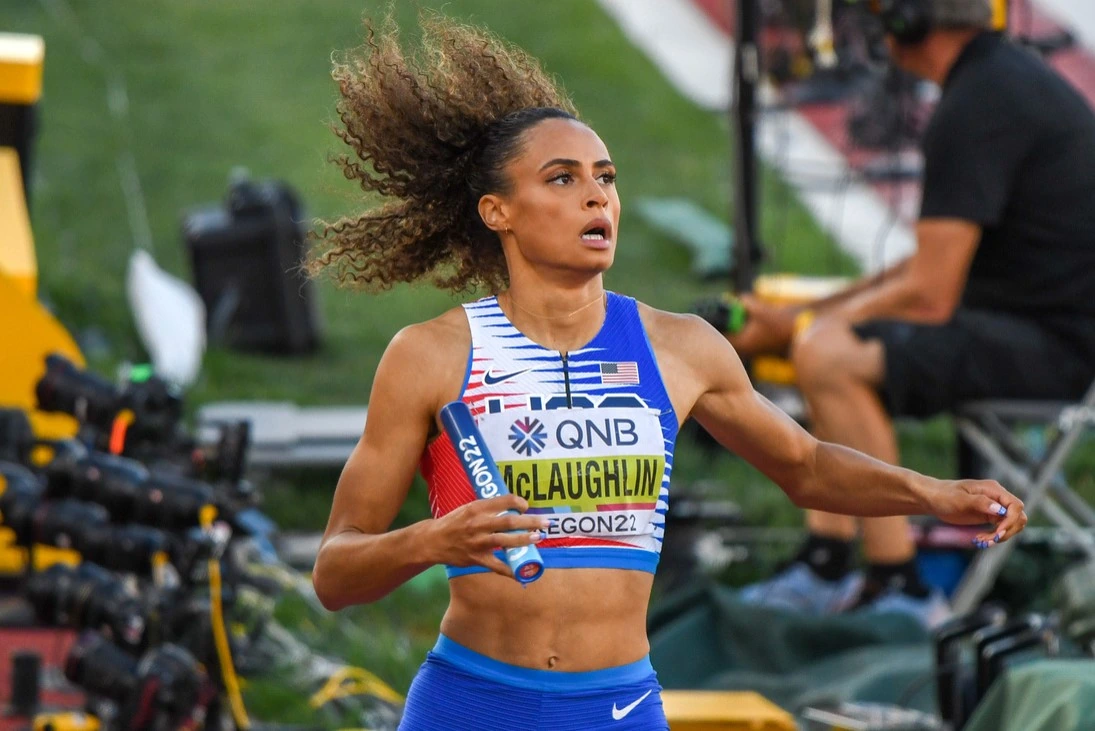
Quick answer: Sydney McLaughlin-Levrone's estimated net worth
Sydney McLaughlin-Levrone's net worth is most commonly estimated at around $2 million to $5 million as of 2026, with many aggregator sites anchoring on the lower $2 million figure. That lower number is almost certainly conservative given what we can verify about her sponsorship portfolio and prize earnings in recent years. The higher end of informal estimates, which some outlets have floated without detailed sourcing, push past $5 million, but those figures also lack transparent backing. For practical research purposes, treat the $2–5 million range as the honest working estimate, with strong upside depending on contract terms that have not been made public. One clarification worth making immediately: Sydney McLaughlin and Sydney McLaughlin-Levrone are the same person. She married NFL wide receiver Andre Levrone Jr. and added his surname, so you will see both names used interchangeably in official documentation, competition records, and brand campaigns. World Athletics' official athlete biography PDFs, for example, list her as 'Sydney MCLAUGHLIN-LEVRONE (USA)' in event materials going back to Budapest 2023.
How net worth estimates actually work (and why sites disagree)

Net worth for athletes and public figures is almost never a precise calculation. It is an inference built from visible data points: documented prize money, confirmed brand deals, publicly announced league contracts, and assumptions about taxes, agent fees, and how much of gross income has been converted into assets. Contrast this with how a serious publication like Forbes approaches billionaire wealth, where the editorial team publicly discloses its methodology, identifies asset types, and applies documented discount rates. Celebrity net worth aggregator sites almost never do that. Most of the pages citing a $2 million figure for McLaughlin-Levrone appear to be repeating each other rather than working from primary earnings data, which is why you should treat any single number as an informed starting point rather than a verified balance sheet figure.
The gap between different estimates also comes down to timing. A site that last updated its page in 2022 will not reflect the $50,000 World Athletics prize for Paris 2024 gold medalists, a new prize structure that made track and field the first Olympic sport to pay direct prize money at the Games. It also will not reflect her Grand Slam Track signing or the compounding value of multi-year brand deals. Whenever you see different numbers on different pages, the first question to ask is: when was this last updated, and what primary sources does it actually reference?
Where her money actually comes from
Prize money and competition earnings

Athletic prize money is among the most verifiable income categories because governing bodies publish the prize structures publicly. World Athletics confirmed that gold medalists at the 2024 Paris Olympics received $50,000 each, a landmark moment since it was the first time prize money was paid directly at an Olympic Games for track and field. McLaughlin-Levrone won the women's 400m hurdles gold in Paris, so that $50,000 payment is as close to a confirmed earnings figure as you will find in public reporting. On top of Olympic prize money, World Athletics' world record programme pays a $100,000 bonus for breaking a world record at the World Athletics Championships. McLaughlin-Levrone holds the world record in the 400m hurdles with a 51.90 seconds, the first officially recognized sub-52-second run in the event's history, which has created multiple bonus eligibility windows across championship cycles. Diamond League prize money adds another layer: the series has increased its prize pool to the highest level in its history for 2025, and top-performing athletes across multiple meets can accumulate significant sums from that circuit alone. Wikipedia’s 2025 Diamond League overview says that starting in 2025, Diamond+ disciplines increased prize money, including doubling typical first-place prizes and setting a $50,000 payout at the Diamond League Finals Diamond League prize money adds another layer.
This is almost certainly the largest single driver of her wealth, and it is also the least transparent. Sponsorship contracts are private documents and athletes are not required to disclose them. What we can do is look at the brands publicly associated with her name. New Balance is a confirmed partner, and the relationship extended into a joint product campaign with TAG Heuer around the Connected Calibre E5 smartwatch, where McLaughlin-Levrone appears prominently as ambassador and campaign face. TAG Heuer had already featured her in advertising for the Connected Calibre E4 before that, so this is a documented multi-year brand relationship, not a one-off appearance. Multi-year ambassador deals with luxury watch brands and global sportswear companies typically involve annual retainer payments well into the six figures, which is why endorsements can dwarf competition prize money for elite athletes at her visibility level.
League contracts and appearance fees

McLaughlin-Levrone was the first athlete to sign with Grand Slam Track, a new professional track and field league. That signing is publicly documented via AP and Reuters-style reporting and represents a direct contracted income source outside of traditional championship prize structures. There is also a concrete, if unusual, data point tied to that deal: subsequent bankruptcy-adjacent coverage of Grand Slam Track listed her among athletes owed money by the league, and included a specific dollar amount. While that situation reflects a payment dispute rather than confirmed earnings, the existence of a documented owed figure gives researchers a floor for estimating the contracted value of her participation in the league. Appearance fees for high-profile meets and invitational events are harder to pin down since those are private agreements, but they are a real income category that net worth models typically estimate based on an athlete's current market tier.
How her earnings likely grew over time
Understanding the trajectory matters because net worth is cumulative. Earnings from 2019 are still part of her asset base today if they were not spent. Here is a rough timeline of the key milestones and how they likely affected her financial picture.
- Pre-2020 (collegiate and early pro years): Limited prize money as an NCAA athlete, early New Balance sponsorship deal established before the Tokyo cycle.
- 2021 (Tokyo Olympics): Won gold in the 400m hurdles and set a world record at the Games. At the time, World Athletics' direct prize money for Olympic medals did not yet exist, so earnings were primarily from endorsement value spikes following the win. Brand deals signed or renewed in this window would have reflected her elevated global profile.
- 2022–2023 (World Championships, continued records): Budapest 2023 World Championships appearance further documented her dominance. A world record at a World Athletics Championships would have triggered the $100,000 world record bonus. Continued multi-year TAG Heuer and New Balance campaigns represent compounding endorsement income during this period.
- 2024 (Paris Olympics): Won Olympic gold again, collecting the new $50,000 World Athletics prize for gold medalists at Paris, the first such payment in Olympic track and field history. Grand Slam Track signing announced, adding a new league contract income stream.
- 2025–2026: Grand Slam Track contract and related disputes documented publicly. Diamond League prize increases for 2025 benefit top-tier athletes like McLaughlin-Levrone. Ongoing brand ambassador roles with TAG Heuer and New Balance continue to generate income.
Each of these milestones compounds. An endorsement deal signed at elevated 2021 rates and renewed in 2024 after a second Olympic gold is worth more than the same deal evaluated in isolation. That compounding dynamic is part of why the $2 million figure likely understates her current position.
What goes into the asset side of the estimate
Net worth is assets minus liabilities, not total career earnings. For athletes, the assets typically included in estimates fall into a few categories. Real estate is often mentioned but rarely verified for track athletes at McLaughlin-Levrone's level, since property records are public but not always matched to athletes in celebrity net worth coverage. Investment accounts and savings are entirely private. Agent and manager fees, which typically run 10–20% of gross earnings for elite athletes, reduce what flows into assets. Federal and state income taxes take another significant chunk. A rough rule of thumb used in athlete wealth modeling is that net assets often represent 30–50% of lifetime gross earnings after taxes, fees, and living expenses, though that varies widely by individual financial management.
Brand deal equity and business interests are another category worth watching as athletes at her tier increasingly negotiate equity stakes rather than straight cash payments. There is no confirmed public evidence of equity arrangements in her case, but it is a relevant category to flag when evaluating estimates that might include or exclude business asset value.
Putting the numbers side by side
| Income Source | Verifiability | Estimated Contribution |
|---|
| Paris 2024 Olympic gold prize | High — publicly confirmed by World Athletics | $50,000 (confirmed structure) |
| World record bonus (World Athletics Championships) | High — prize structure publicly published | $100,000 per eligible record at championships |
| Diamond League prize money | Medium — structure public, athlete-specific amounts vary | Potentially $50,000–$200,000+ across multiple seasons |
| Grand Slam Track contract | Medium — signing confirmed, amount partially indicated via owed-payment reporting | Undisclosed, but documented as a contracted figure |
| TAG Heuer ambassador deal (multi-year) | Medium — campaigns publicly documented, contract value private | Estimated high six figures annually for multi-year luxury deals |
| New Balance sponsorship | Medium — brand relationship confirmed across multiple campaigns | Estimated six figures annually, likely higher post-2021 |
| Real estate and investments | Low — private, not publicly documented for this athlete | Speculative; included in most estimates without sourcing |
How to verify what you read about her net worth
The single most useful habit when researching a figure like this is separating primary evidence from site-to-site repetition. A celebrity net worth aggregator page that does not cite a press release, a public contract announcement, or a reputable financial outlet is essentially giving you an opinion, not a calculation. Here is a practical verification workflow.
- Check the World Athletics official site for prize money structures. They publish the breakdown for World Championships and have issued press releases specifically about the world record bonus programme and the 2024 Olympic prize payments. These are primary sources you can read directly.
- Search for brand deal announcements via press releases from New Balance, TAG Heuer, or the athlete's management team. The TAG Heuer / New Balance Calibre E5 collaboration materials are publicly accessible and confirm her ambassador status.
- Look for AP or Reuters-style wire reporting on league contracts. Her Grand Slam Track signing was covered by newswire sources, which are more reliable than lifestyle blogs.
- For Diamond League earnings, check the World Athletics Diamond League section for published prize money structures, then apply realistic assumptions about finish positions across a season.
- Cross-reference any net worth figure you find with the site's methodology disclosure. If they do not explain how they arrived at the number, weight it accordingly.
- Use Wikipedia as a quick identity and career timeline reference, but not as a financial source. It is useful for confirming that McLaughlin and McLaughlin-Levrone are the same person and for checking major career dates, not for income figures.
It is also worth comparing how wealth is built across different athlete profiles at similar career stages. Ami McClure's net worth profile, for instance, illustrates how digital and media-driven income sources can create a different wealth-building trajectory than traditional sports prize money. Similarly, if you are trying to understand how younger athletes' earnings profiles develop before major endorsement deals kick in, looking at a profile like Ella McFadin's net worth gives you a useful contrast in scale and income mix.

The $2 million figure that circulates widely is probably based on data from earlier in her career, before the 2024 Olympic prize money, before the Grand Slam Track signing, and before the TAG Heuer relationship deepened into a multi-product campaign partnership. It also does not reflect the compound effect of a second Olympic gold on endorsement rates. Athletes at this level see step-function increases in their marketability after major milestones, and the 2024 Paris cycle was the biggest of her career in commercial terms. A more current model built from the publicly available inputs above would likely land meaningfully above $2 million, though confirming a precise figure is impossible without access to private contract terms.
For additional context on how endorsement-heavy income profiles compare to those built around media and entertainment crossover, the Elle McNamara net worth profile and the Ellen McIlwaine net worth profile both offer useful reference points for how differently wealth can accumulate depending on which income categories dominate a career. In McLaughlin-Levrone's case, endorsements are almost certainly the dominant driver, which means her net worth trajectory is more sensitive to brand deal renewals than to any single race result.
The bottom line: use $2–5 million as your working range, weight toward the higher end given documented 2024 and 2025 earnings milestones, and treat any single round number from an aggregator site as a starting point for your own verification rather than a settled answer.